PScoat explainer graphics
How the PScoat coating system is explained: ceramic vacuum nanospheres, the Knudsen effect, reflection in summer and winter, and the layer system. All pictures are schematic illustrations or models, not measurements. Test reports and data sheets are listed on the evidence page.
Ceramic vacuum nanosphere: shell and vacuum core (schematic)
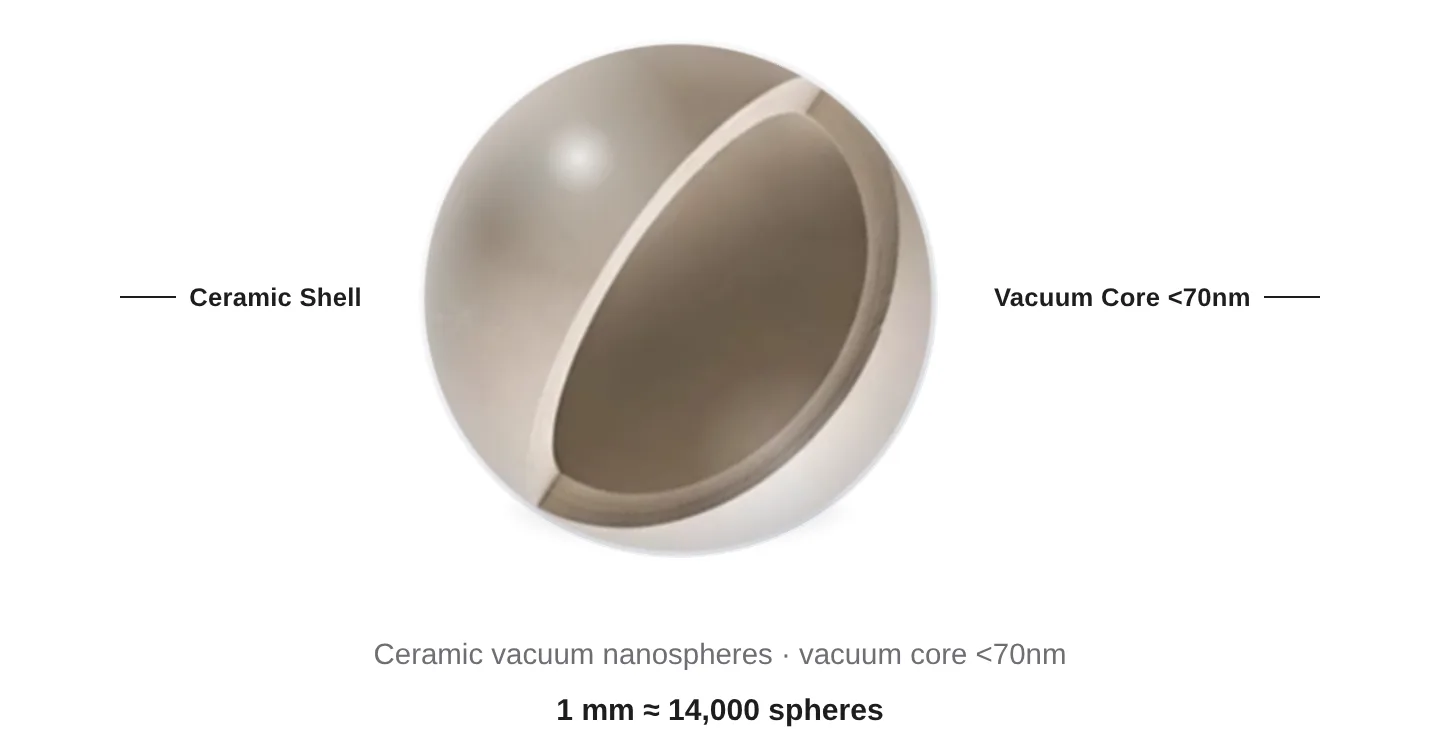
A cut-open ceramic sphere with a shell and a vacuum core. The labels read 'Ceramic Shell', 'Vacuum Core <70nm' and '1 mm ≈ 14,000 spheres'. PScoat's coating is made of exactly these ceramic vacuum nanospheres; applied as a coating it dries to a thin protective layer. The picture is a schematic illustration of the principle.
- What are ceramic vacuum nanospheres?
- The building blocks of PScoat: tiny ceramic spheres with a vacuum core that make up the insulating coating.
- How large is the vacuum core?
- Below 70 nanometres, with about 14,000 spheres in every millimetre of coating.
Knudsen lab: pore size, gas pressure and heat conduction through gas (model)
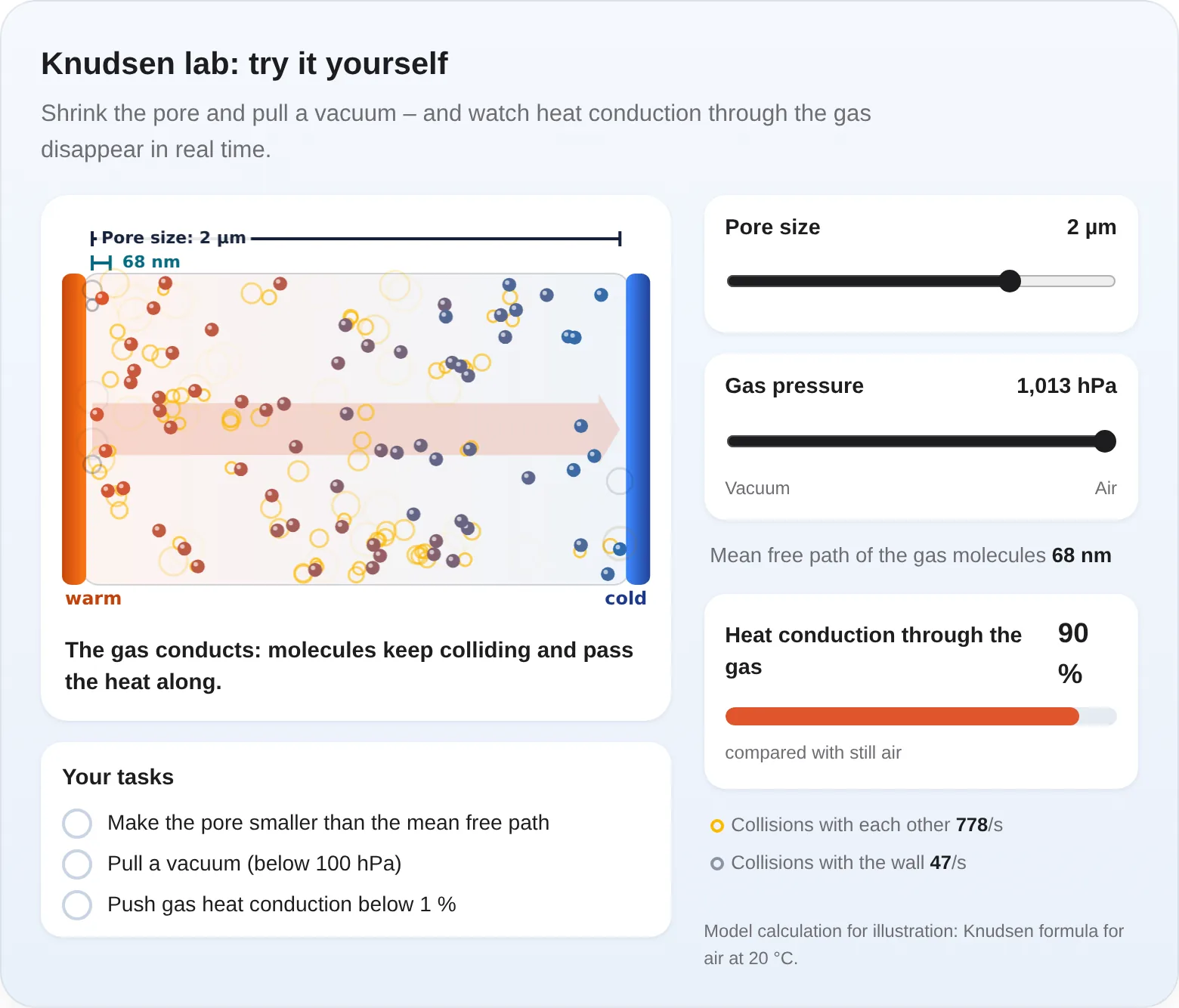
The Knudsen lab is an interactive model. Two sliders set the pore size and the gas pressure between a warm and a cold wall. Moving molecules, collision counters and a bar show how much heat the gas conducts compared with still air. Once the pore is smaller than the mean free path of the gas molecules (about 68 nm for air at normal pressure), the molecules hit the wall more often than each other and gas conduction collapses: the Knudsen effect, the principle behind PScoat's vacuum nanospheres. The model uses the Knudsen formula for air at 20 °C.
- What is the Knudsen effect?
- When pores are smaller than the mean free path of the gas molecules, heat conduction through the gas is suppressed.
- What does the lab show about PScoat?
- The principle that PScoat's vacuum nanospheres use. The lab itself is a model calculation, not a test result.
Wall cross-section: the vacuum is in the spheres, not in the wall (schematic)
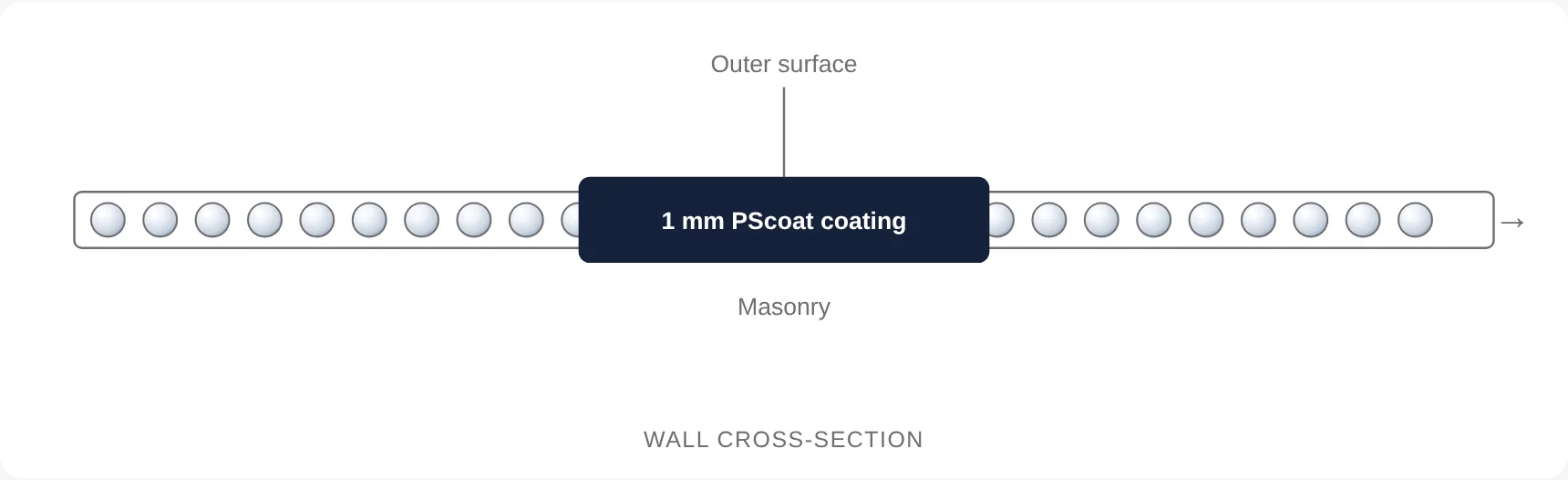
The diagram shows a wall section: masonry on one side, a row of small spheres, and a box labelled '1 mm PScoat coating' at the outer surface. In PScoat's coating the vacuum is not in the wall but sealed inside the ceramic spheres. The coating is applied like a paint and dries to a thin layer; the facade system is about 1 mm thick in total.
- Where is the vacuum?
- Inside the ceramic spheres of the coating, not in the wall; each cell is sealed with a vacuum.
- How thick is the facade system?
- About 1 mm in total: primer plus main coat in layers of at most 0.5 mm.
Wall section, hot country: solar radiation reflected at the outer sphere layer (schematic)
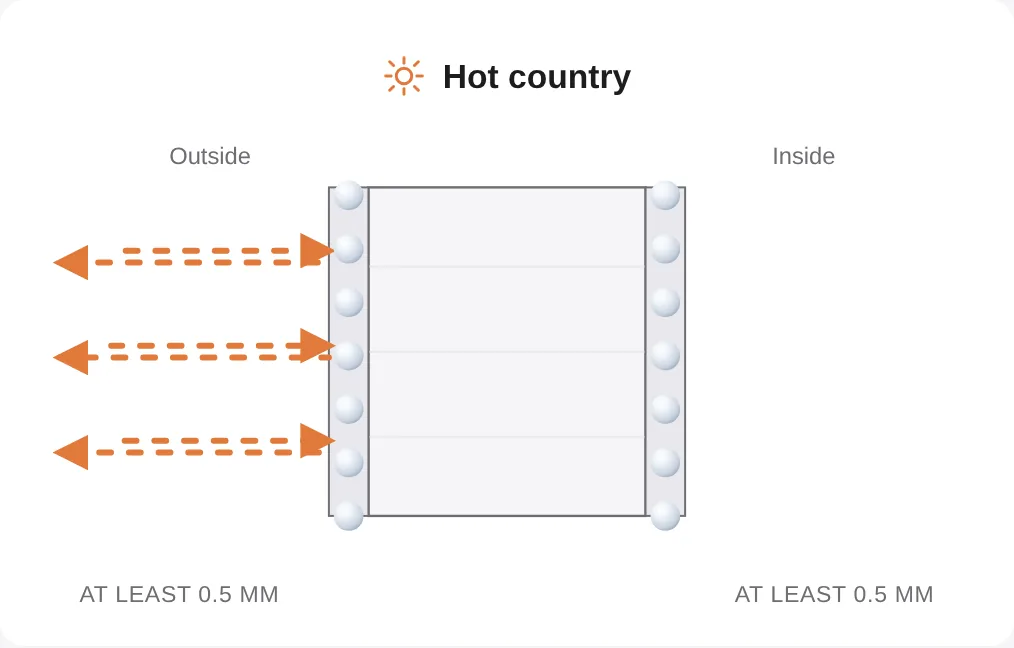
The wall-section diagram 'Hot country' shows orange arrows for solar radiation coming from the outside and turning back at the outer sphere layer, while the inside stays without arrows. Both layers are labelled 'at least 0.5 mm'. PScoat reflects solar radiation at the surface; the total solar reflectance (TSR) is 91–92 % depending on the product, for light shades.
- What does the diagram show?
- Solar radiation being reflected at the outer sphere layer of PScoat's coating.
- How much solar radiation does PScoat reflect?
- 91–92 % total solar reflectance depending on the product, for light shades.
Wall section, cold country: radiation reflected at the sphere layers on both sides (schematic)
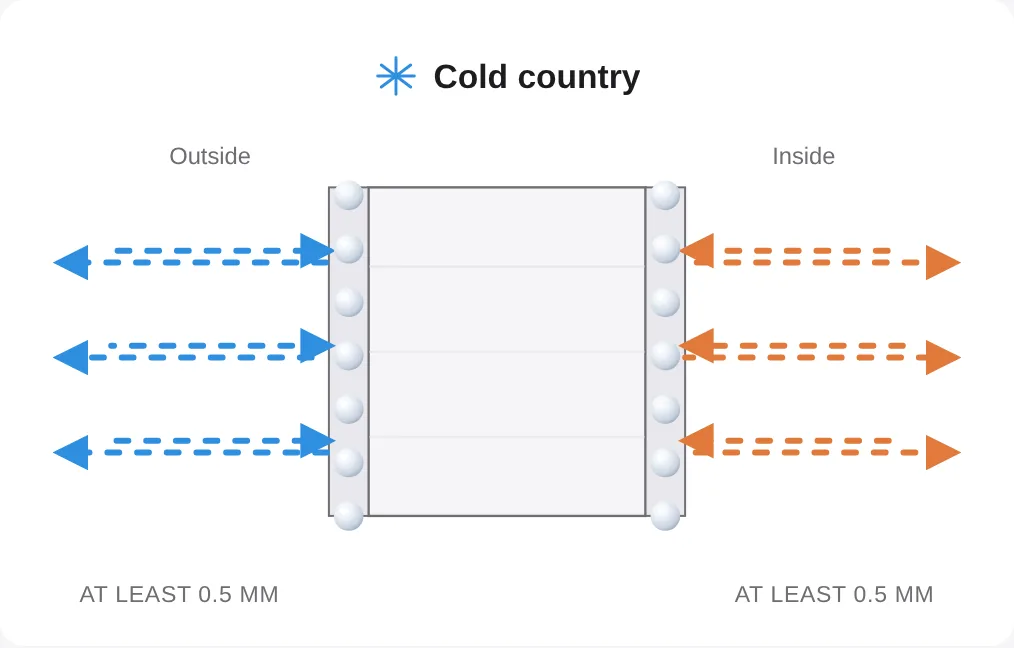
The wall-section diagram 'Cold country' shows blue arrows from the outside and orange arrows from the inside, each turning back at a thin sphere layer on its side of the wall. PScoat's sphere layers reflect radiation on both sides of the wall. The blue arrows stand, simplified, for the influence of cold from outside. The layers are labelled 'at least 0.5 mm'.
- What do the blue and orange arrows mean?
- Blue stands, simplified, for cold from outside; orange for warmth from inside the room.
- Is this a measurement?
- No, it is a schematic illustration of the reflection principle.
House diagram, summer: coated roof and walls reflect solar radiation (schematic)
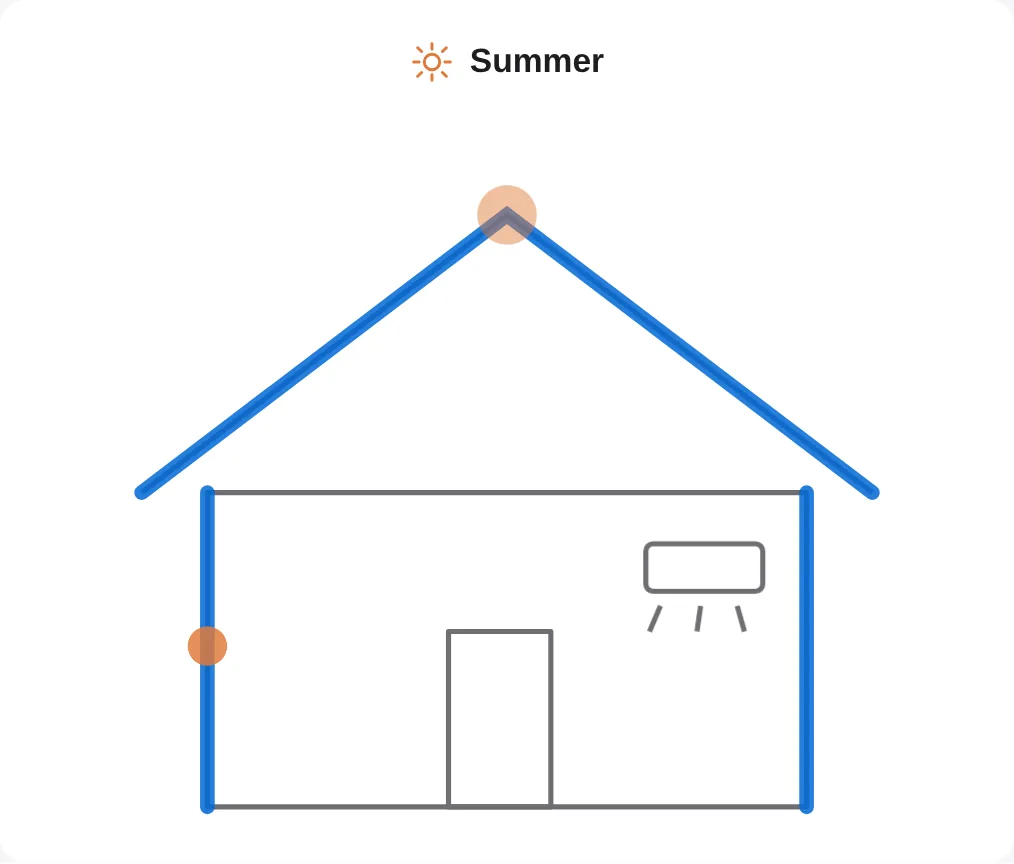
The house diagram 'Summer' shows a house with roof and exterior walls drawn in blue, a sun symbol above the ridge and an air-conditioning unit inside. The coated roof and wall surfaces reflect solar radiation; the total solar reflectance (TSR) is 91–92 % depending on the product, for light shades. The picture illustrates the principle; actual effects depend on building, climate and use.
- What does the summer diagram show?
- That PScoat reflects solar radiation at the coated roof and wall surfaces.
- Does the diagram promise a saving?
- No. It illustrates the principle; actual effects depend on the building, the climate and its use.
House diagram, winter: heating warmth reflected back at the coated surfaces (schematic)
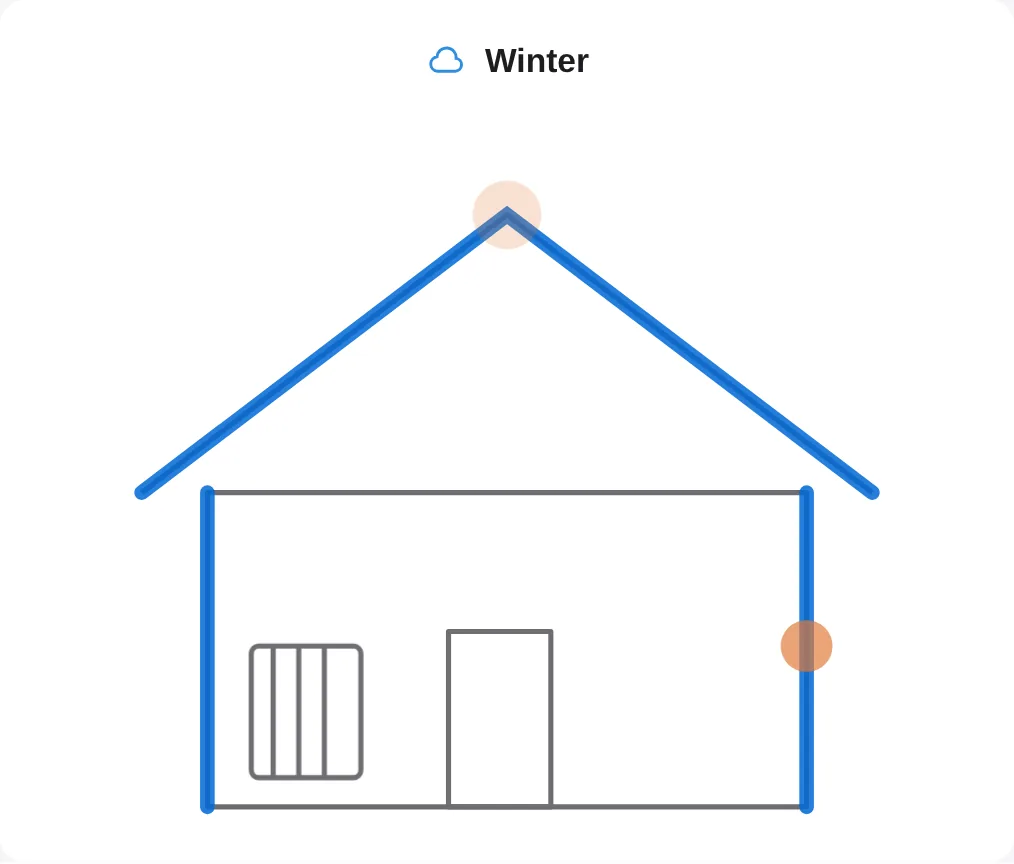
The house diagram 'Winter' shows roof and exterior walls in blue, a radiator in the room and a cloud symbol. PScoat reflects heating warmth back into the rooms at the coated surfaces instead of letting it escape outward. The picture illustrates the principle; actual effects depend on building, climate and heating.
- What does the winter diagram show?
- That PScoat reflects heating warmth back into the rooms at the coated surfaces.
- Does the diagram promise a saving?
- No. It illustrates the principle; actual effects depend on the building, the climate and the heating.
The PScoat system layer by layer: roof and wall (schematic)

The diagram shows PScoat's one coating system for roof and wall: a blue line runs along a wall and a pitched roof and is labelled PSC Roof, PSC Build, PSC Outside, PSC Basic and, indoors, PSC Interior. A magnifier shows the ceramic vacuum nanospheres. The label '92% reflectance (TSR)' stands for 92 ± 1 % for light shades (ECR Roof 91 ± 1 %).
- Which layers does the system contain?
- A primer (PSC Basic), a main layer (PSC Build), a finish (PSC Outside), PSC Roof for roofs and PSC Interior indoors.
- Where can I find the product data?
- On the evidence page: certificates, test reports and data sheets with issuer, date and scope.
Learning Studio modules
The PScoat Learning Studio is an interactive learning tool. Its five modules are shown here as pictures with explanations. All results are models for illustration.
Learning Studio: from the sphere to the wall (3D lesson)
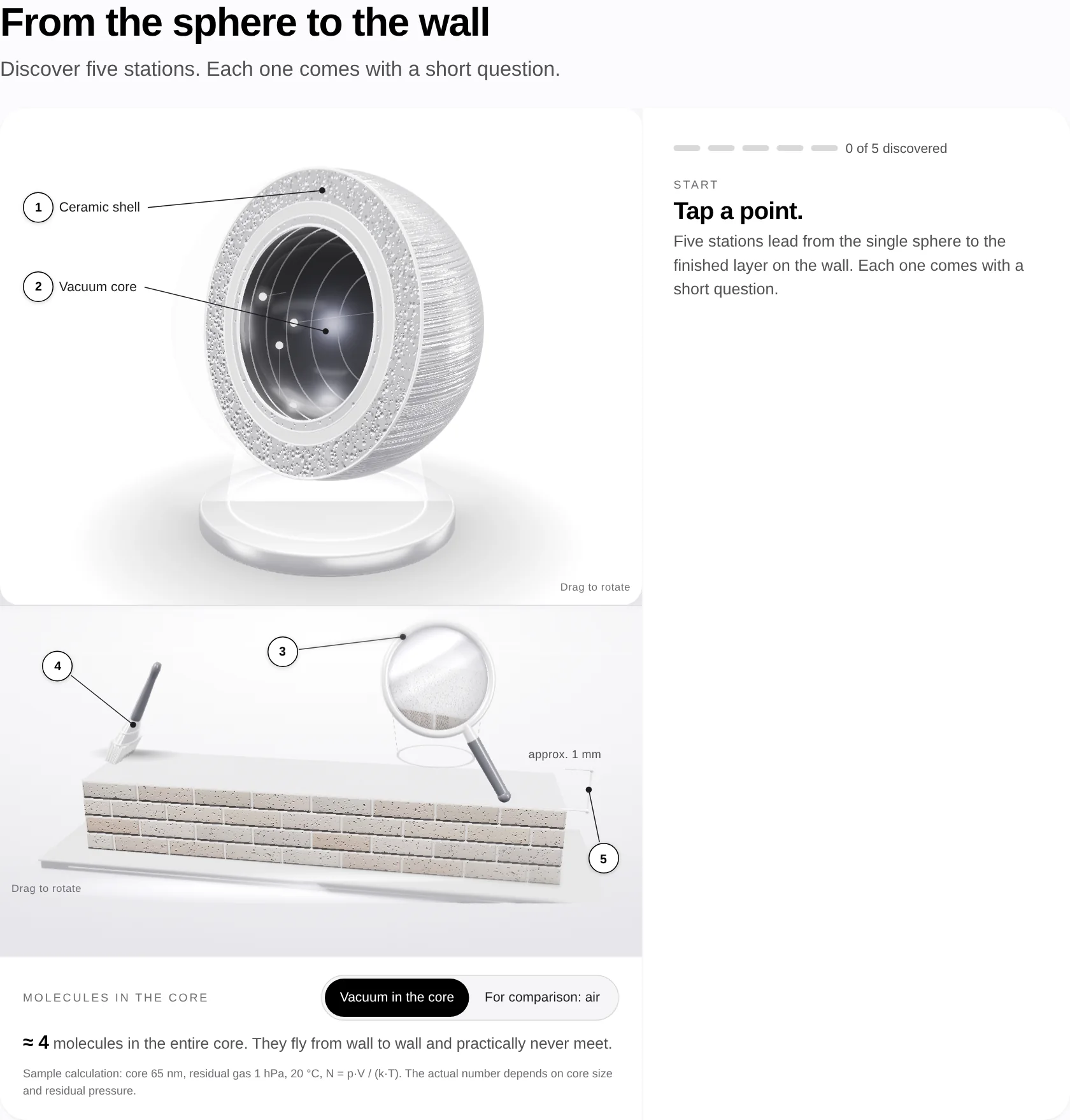
The first module of the PScoat Learning Studio shows a cut-open ceramic sphere in 3D. Numbered points mark the ceramic shell and the vacuum core; a second view shows the finished layer of about 1 mm on a brick wall with a magnifier. Five stations each come with a short question, and a counter shows how many have been discovered. A sample calculation compares the number of gas molecules in a sphere core with air; the actual number depends on core size and residual pressure.
- What do the five stations show?
- The way from the single ceramic sphere with its shell and vacuum core to the finished layer of about 1 mm on the wall.
- Is the molecule count a measurement?
- No. It is a sample calculation with the ideal gas law; the actual number depends on core size and residual pressure.
Learning Studio: Knudsen lab with winter and summer temperature (model)
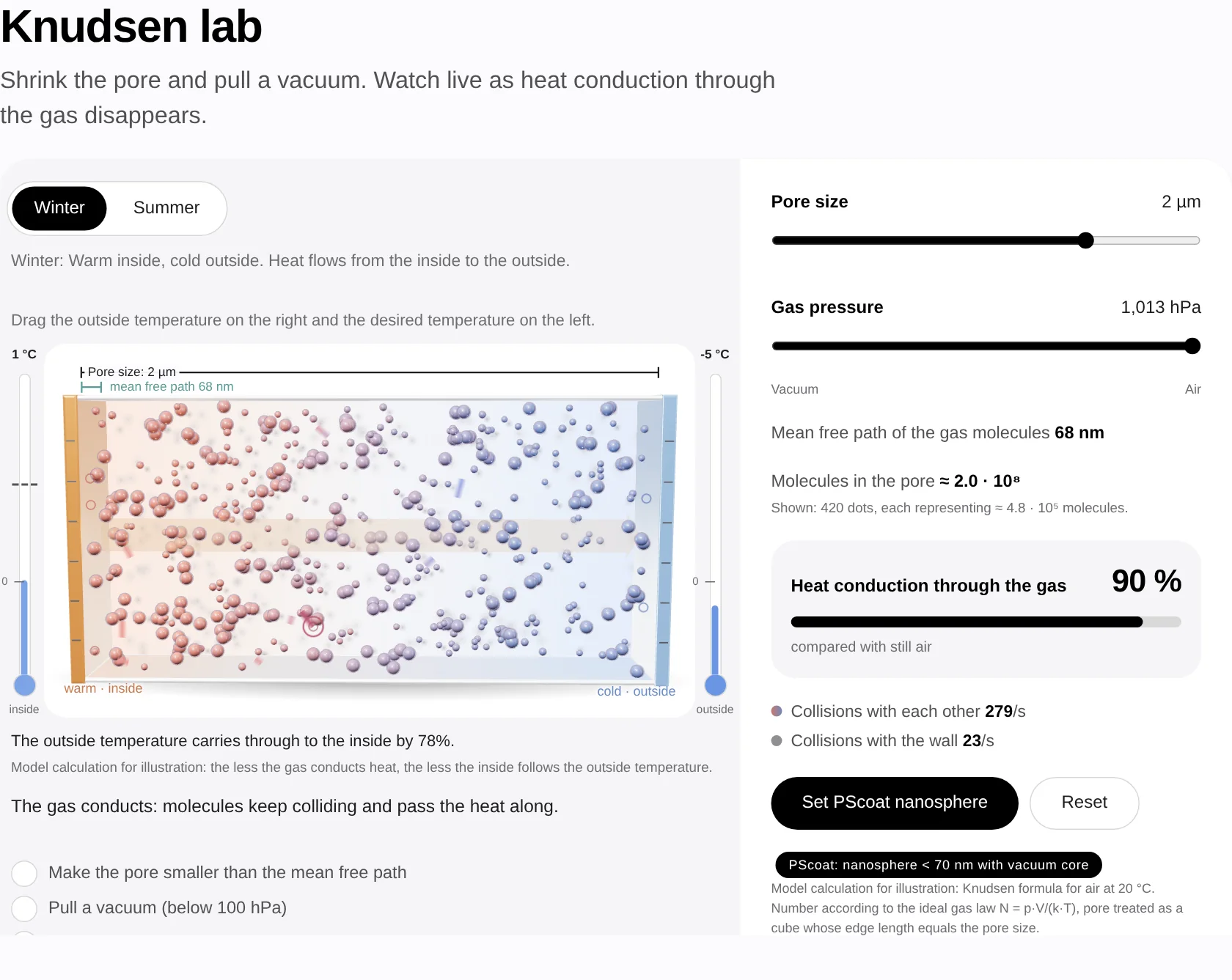
The Knudsen lab of the Learning Studio extends the model with a winter and summer switch. Two temperature sliders set the outside and desired inside temperature; a pore with moving gas molecules sits between a warm and a cold wall. Sliders for pore size and gas pressure change the mean free path and the share of heat conducted through the gas, shown as a percentage compared with still air. Three tasks guide the user: make the pore smaller than the mean free path, pull a vacuum below 100 hPa, and push gas conduction below 1 %. A button sets the values of the PScoat nanosphere.
- What can I change in the lab?
- Season, outside and inside temperature, pore size and gas pressure; the lab shows the resulting heat conduction through the gas.
- Does the lab test a product?
- No. It is a model calculation for illustration with the Knudsen formula for air at 20 °C.
Learning Studio: where the heat stays, wall scene for hot and cold climate
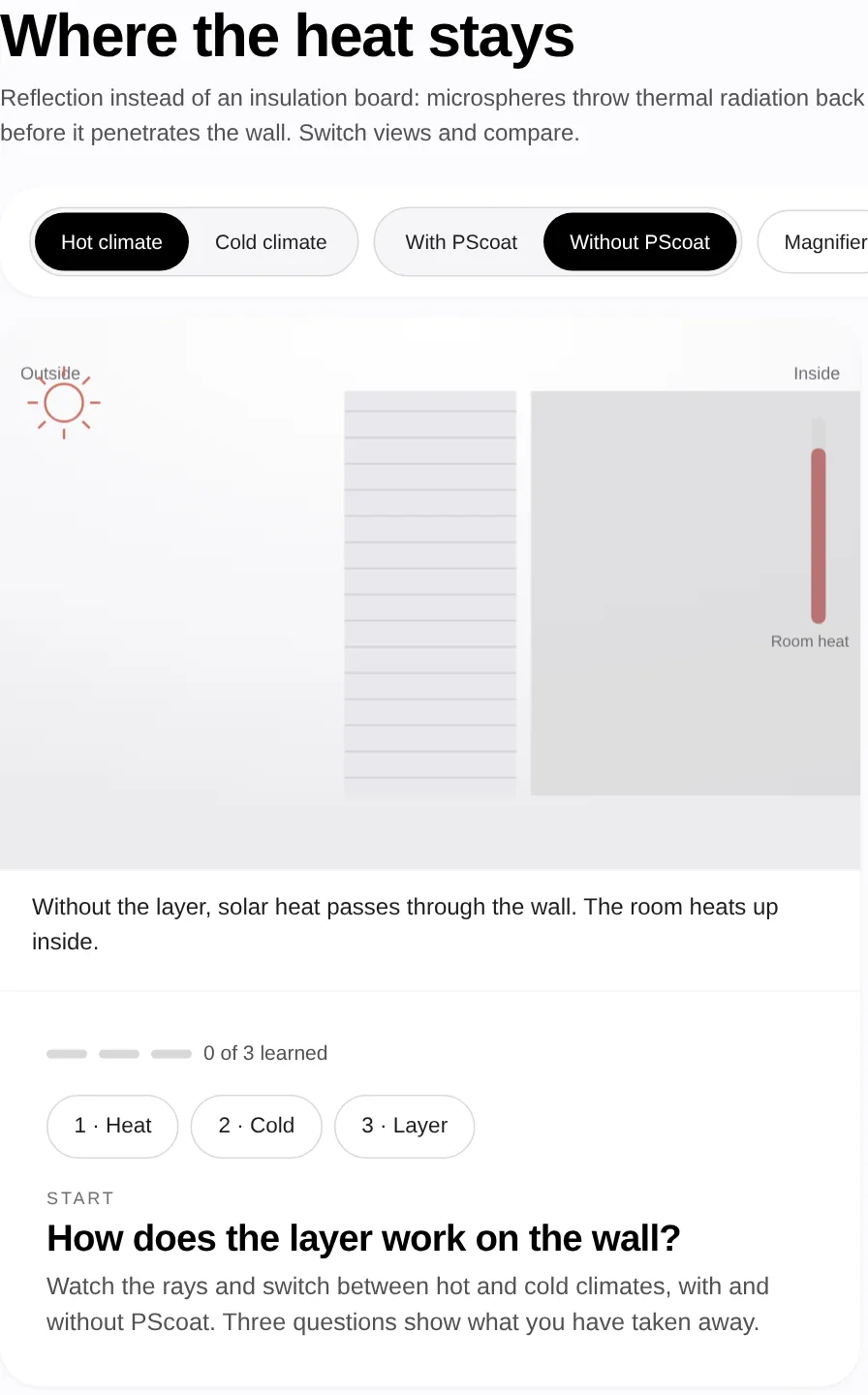
The wall scene shows a wall with a sun symbol outside and a room with a heat bar inside. Buttons switch between hot and cold climate, with and without PScoat, and open a magnifier view of the layer. PScoat's microspheres throw thermal radiation back at the surface before it penetrates the wall. Three questions (heat, cold, layer) check what the user has taken away. The scene is a teaching illustration and does not predict the result for a specific building.
- What can I switch in the wall scene?
- Hot or cold climate, with or without PScoat, and a magnifier on the layer.
- Does the scene predict results for my house?
- No. It illustrates the principle; actual effects depend on building, climate and use.
Learning Studio: house model for roof and facade in summer and winter
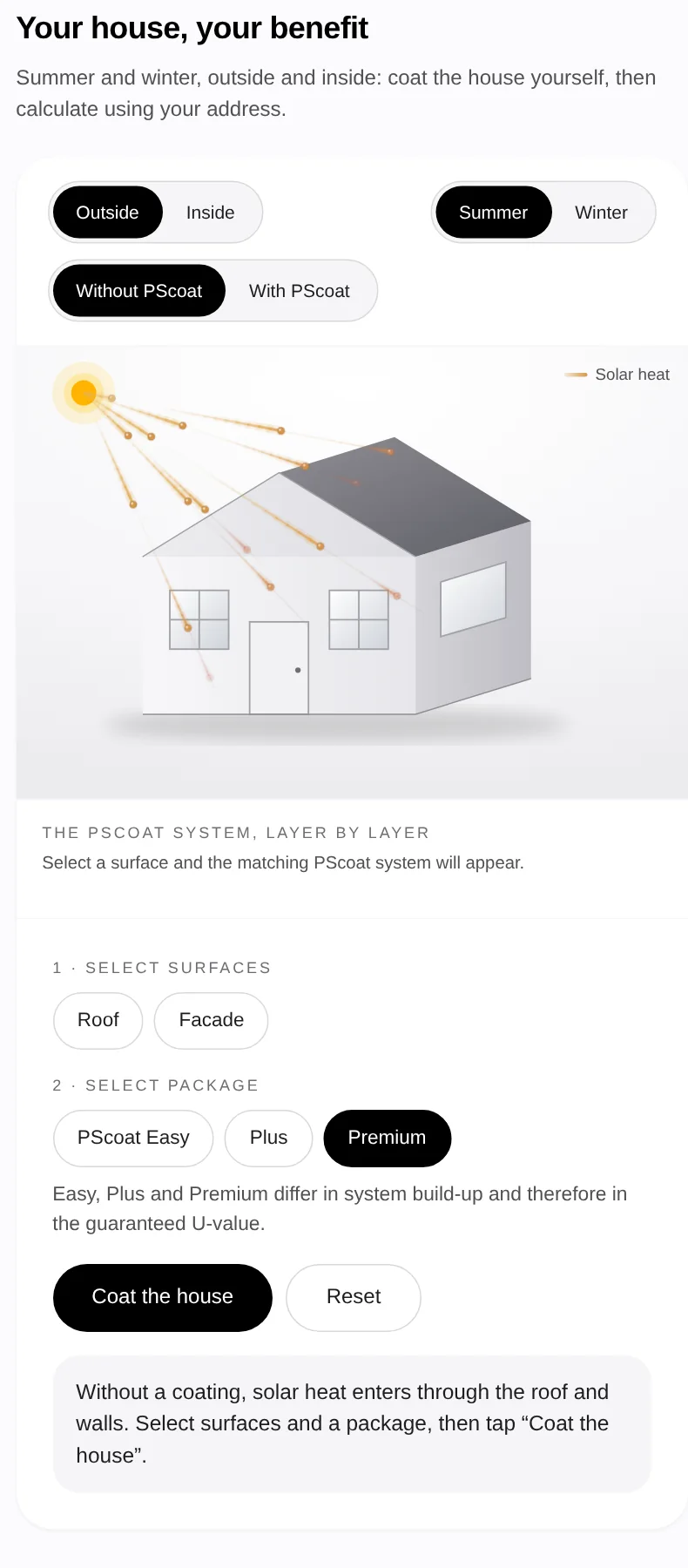
In the house model you coat a 3D house yourself. Switches change between outside and inside view, summer and winter, and without or with PScoat. In two steps you select the surfaces, roof and facade, and a package, PScoat Easy, Plus or Premium; the matching PScoat system appears layer by layer, and the button 'Coat the house' applies it. The model explains where solar heat enters in summer and how the layers are built up. It is an illustration and does not replace an object-specific calculation.
- What can I select in the house model?
- Surfaces (roof, facade), a package (Easy, Plus, Premium), summer or winter, outside or inside, and with or without PScoat.
- Is the model an object-specific calculation?
- No. It explains the principle; an object-specific calculation needs the real building data.
Learning Studio: your own house in four steps, address calculator and material demand
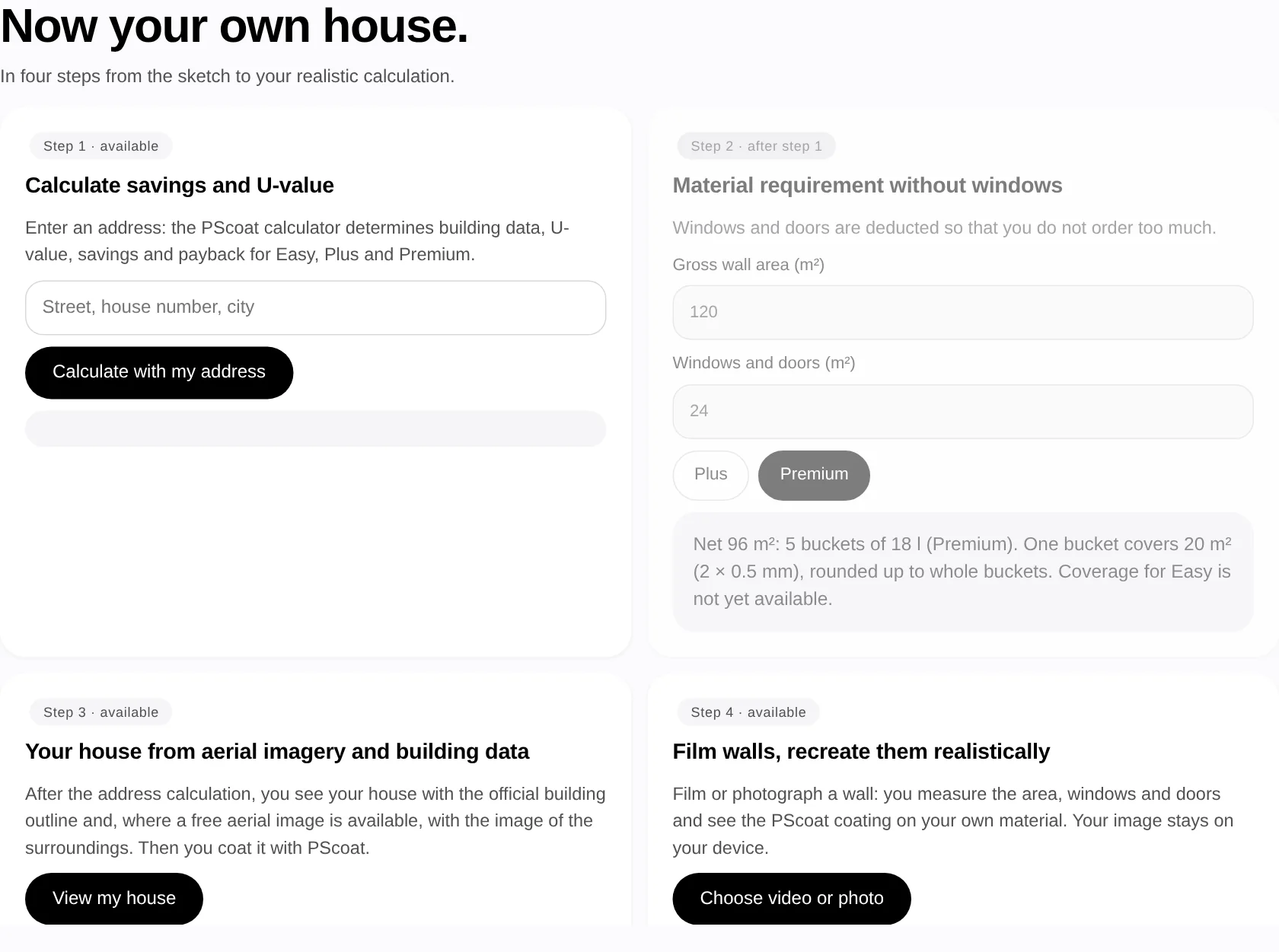
The last module leads from the sketch to a realistic calculation in four steps. Step 1: enter an address and the PScoat calculator determines building data and calculates for Easy, Plus and Premium. Step 2: the material requirement is calculated without windows and doors, rounded up to whole 18 l buckets. Step 3: the house is shown from aerial imagery and official building data. Step 4: film or photograph a wall to measure area, windows and doors and see the coating on your own material; the image stays on your device. All results are model calculations and depend on the building.
- What are the four steps?
- Address calculation, material requirement, house from aerial imagery and building data, and filmed walls.
- Are the results binding?
- No. They are model calculations; a binding offer comes from the local PScoat site.
Explainer clips
Eleven short clips (English, with captions and transcript). They explain the principles shown above.
Transcript
In summer, solar radiation hits the coated roof. The ceramic vacuum nanospheres reflect 92 percent of the solar energy. The roof space heats up noticeably less. The reason: the nanospheres' vacuum core – the Knudsen effect blocks heat conduction through gas. 92 percent reflection, U-value 0.14.Transcript
On the facade, solar heat is reflected at the coated render instead of being absorbed. The wall stays cooler, so the air conditioning runs less often. The reason: the nanospheres' vacuum core – the Knudsen effect blocks heat conduction through gas. 92 percent reflection, U-value 0.14.Transcript
In winter the coating works the other way round. Heating warmth that reaches the roof from inside is reflected back into the room. Heat loss through the roof is reduced. The reason: the nanospheres' vacuum core – the Knudsen effect blocks heat conduction through gas. 92 percent reflection, U-value 0.14.Transcript
At the wall too, heating warmth stays inside the house. The roughly one millimetre thin layer reflects the radiation back inward, so the wall surface feels warmer. The reason: the nanospheres' vacuum core – the Knudsen effect blocks heat conduction through gas. 92 percent reflection, U-value 0.14.Transcript
Ceramic vacuum nanospheres: a vacuum core under 70 nanometres, surrounded by a ceramic shell. One millimetre of coating contains about 14,000 of these spheres – CE certified to EN 15824 and TÜV NORD verified.Transcript
When the vacuum core is smaller than the gas molecule's mean free path, conduction through gas is suppressed – known as the Knudsen effect. The vacuum inside each sphere eliminates convection and conduction through gas.Transcript
Ceramic vacuum nanospheres are applied as a coating and dry into a 1 millimetre protective layer. U-value 0.14 watts per square metre kelvin at only about 0.5 millimetres, compared with 200 millimetres for EPS or mineral wool.Transcript
Hot country: sun heat hits the PScoat layer and is reflected back outward. The interior stays cooler.Transcript
Cold country: cold from outside is reflected before it reaches the wall. Warmth generated inside is reflected back into the room.Transcript
The PScoat system, layer by layer: PSC Roof, PSC Build, PSC Outside and PSC Basic on the facade, PSC Interior indoors – one coating system for roof and wall with 92 percent reflectance.Transcript
Benefits: easy application and excellent protection. Protection: against heat loss and against corrosion. Ecology: water-based as an aqueous acrylate dispersion, and not classified as hazardous to the environment according to the safety data sheet.Product renders
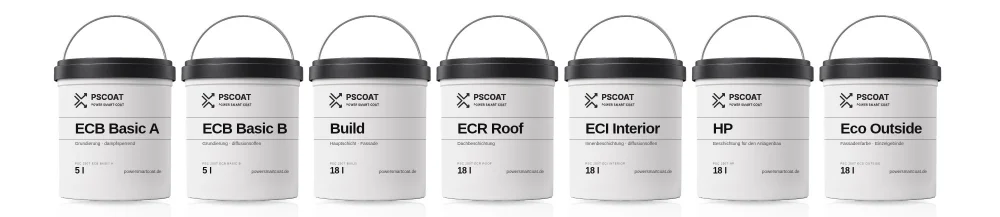
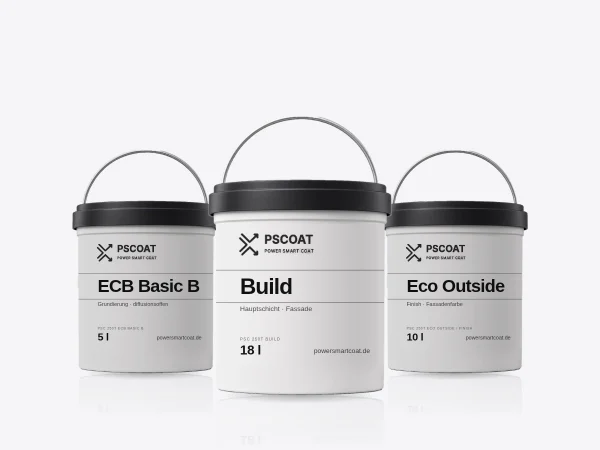
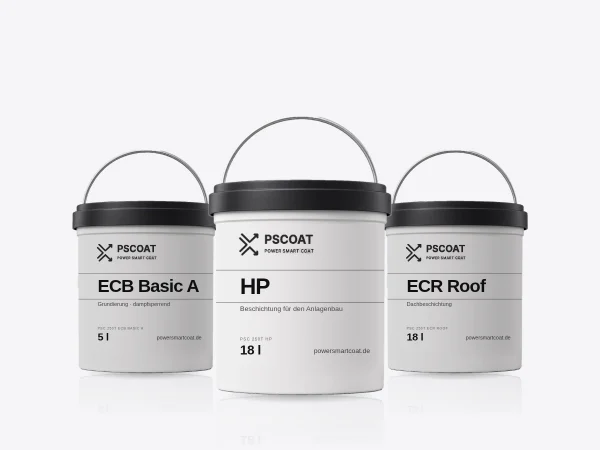
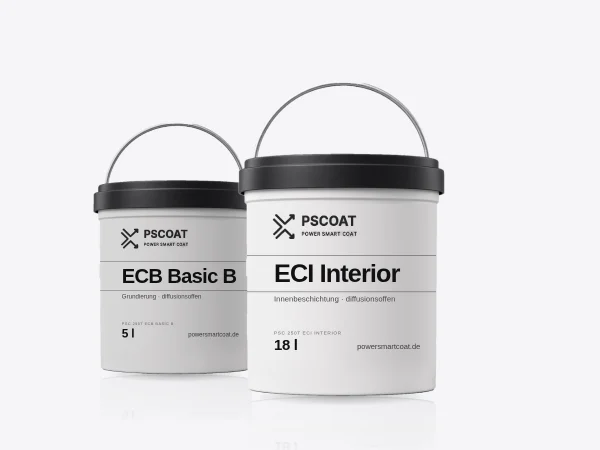
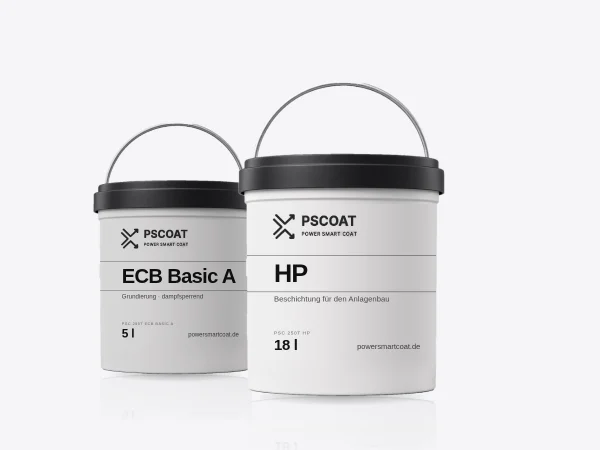
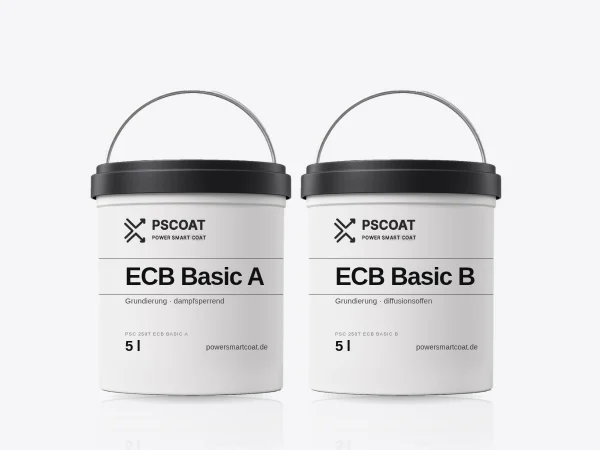
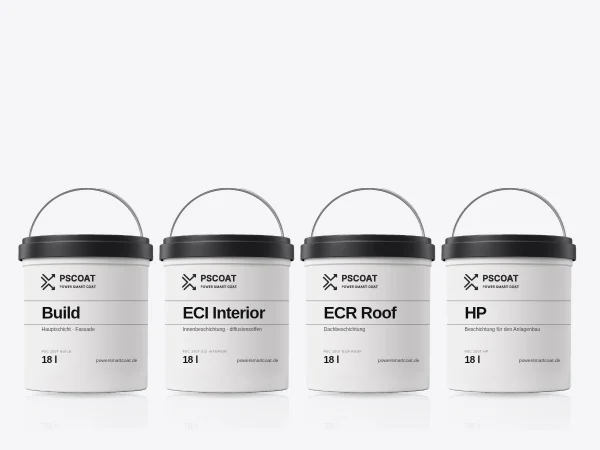
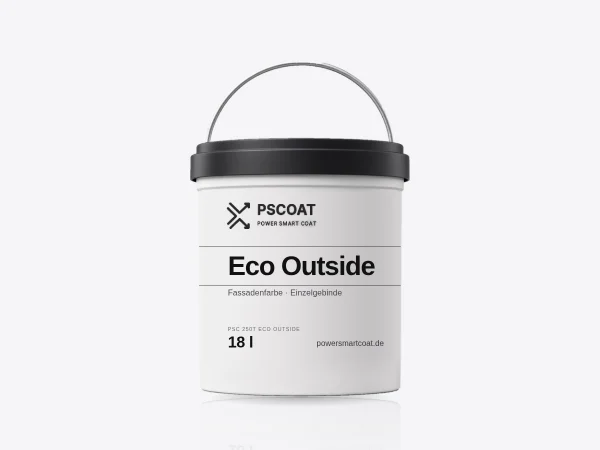
Packaging renders of the PSC 250T range (not photos of finished objects and not performance evidence). Pack sizes and availability depend on your country; find your local PScoat site on the world portal.